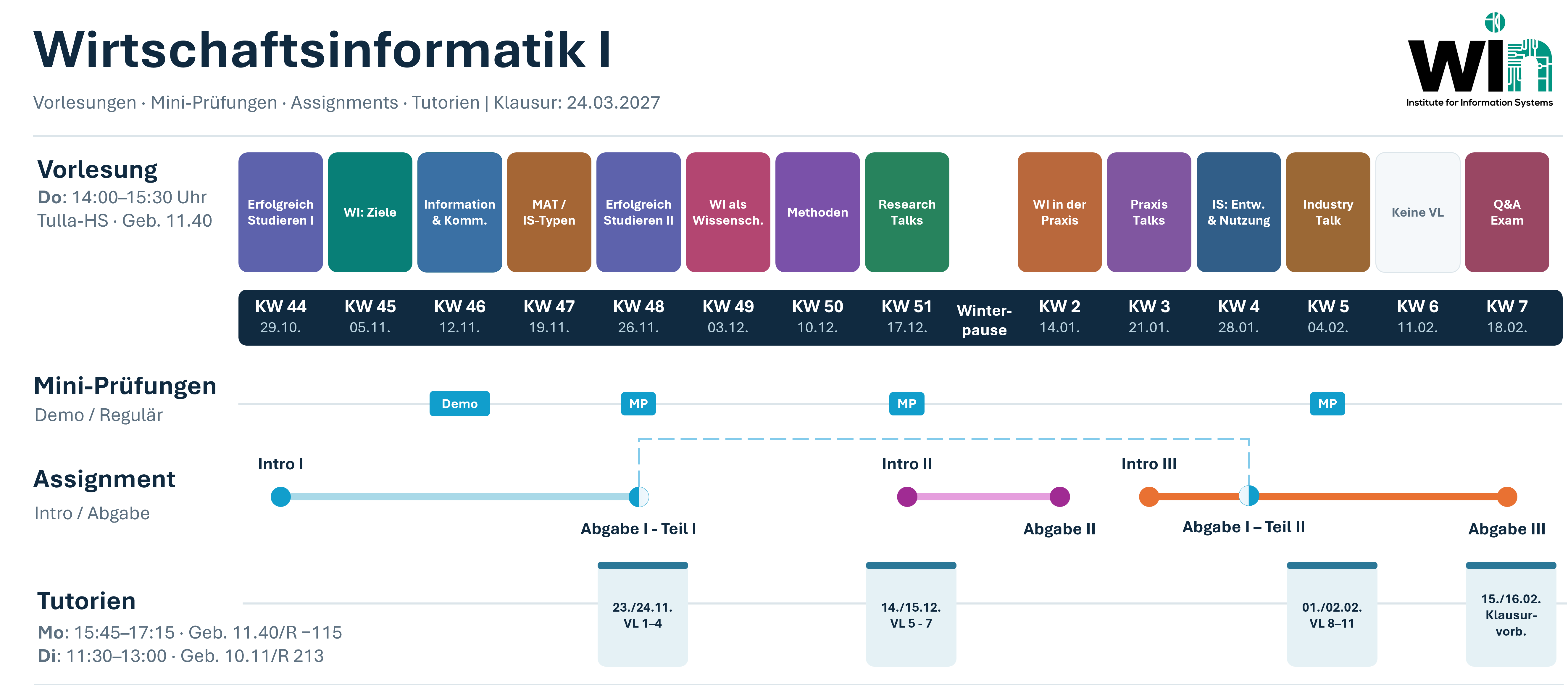
Wirtschaftsinformatik I (Information Systems I)
- Type: Lecture (V)
- Chair: Institute of Information Systems
- Semester: WS 26/27
-
Time:
Thu 2026-10-29
14:00 - 15:30, weekly
11.40 Johann-Gottfried-Tulla-Hörsaal
11.40 Kollegiengebäude am Ehrenhof (1. OG)
Thu 2026-11-05
14:00 - 15:30, weekly
11.40 Johann-Gottfried-Tulla-Hörsaal
11.40 Kollegiengebäude am Ehrenhof (1. OG)
Thu 2026-11-12
14:00 - 15:30, weekly
11.40 Johann-Gottfried-Tulla-Hörsaal
11.40 Kollegiengebäude am Ehrenhof (1. OG)
Thu 2026-11-19
14:00 - 15:30, weekly
11.40 Johann-Gottfried-Tulla-Hörsaal
11.40 Kollegiengebäude am Ehrenhof (1. OG)
Thu 2026-11-26
14:00 - 15:30, weekly
11.40 Johann-Gottfried-Tulla-Hörsaal
11.40 Kollegiengebäude am Ehrenhof (1. OG)
Thu 2026-12-03
14:00 - 15:30, weekly
11.40 Johann-Gottfried-Tulla-Hörsaal
11.40 Kollegiengebäude am Ehrenhof (1. OG)
Thu 2026-12-10
14:00 - 15:30, weekly
11.40 Johann-Gottfried-Tulla-Hörsaal
11.40 Kollegiengebäude am Ehrenhof (1. OG)
Thu 2026-12-17
14:00 - 15:30, weekly
11.40 Johann-Gottfried-Tulla-Hörsaal
11.40 Kollegiengebäude am Ehrenhof (1. OG)
Thu 2027-01-07
14:00 - 15:30, weekly
11.40 Johann-Gottfried-Tulla-Hörsaal
11.40 Kollegiengebäude am Ehrenhof (1. OG)
Thu 2027-01-14
14:00 - 15:30, weekly
11.40 Johann-Gottfried-Tulla-Hörsaal
11.40 Kollegiengebäude am Ehrenhof (1. OG)
Thu 2027-01-21
14:00 - 15:30, weekly
11.40 Johann-Gottfried-Tulla-Hörsaal
11.40 Kollegiengebäude am Ehrenhof (1. OG)
Thu 2027-01-28
14:00 - 15:30, weekly
11.40 Johann-Gottfried-Tulla-Hörsaal
11.40 Kollegiengebäude am Ehrenhof (1. OG)
Thu 2027-02-04
14:00 - 15:30, weekly
11.40 Johann-Gottfried-Tulla-Hörsaal
11.40 Kollegiengebäude am Ehrenhof (1. OG)
Thu 2027-02-11
14:00 - 15:30, weekly
11.40 Johann-Gottfried-Tulla-Hörsaal
11.40 Kollegiengebäude am Ehrenhof (1. OG)
Thu 2027-02-18
14:00 - 15:30, weekly
11.40 Johann-Gottfried-Tulla-Hörsaal
11.40 Kollegiengebäude am Ehrenhof (1. OG)
-
Lecturer:
Prof. Dr. Alexander Mädche, Prof. Dr. Philipp Staudt, Dr. Julia Seitz Sänger
- SWS: 2
- Lv-No.: 2540425
- Information: Blended (On-Site/Online)
The "Information Systems I" lecture covers the fundamental principles of the discipline as it exists in both academia and practice. It introduces the subject matter and objectives of information systems, along with key concepts and the discipline's primary objects of study. Students gain an understanding of the role of theory and research methods within the field from a scientific perspective. From a practical standpoint, they are introduced to important practice methods and the information systems lifecycle. Students apply selected concepts by developing prototypes, thereby recognizing the importance of interdisciplinary skills for their studies and future careers.
Learning objectives: The student…
- can describe the subject matter and objectives of the discipline of Information Systems, as well as articulate its core objects of study and illustrate them with examples.
- can define the concepts of information and communication and situate them within the context of Information Systems.
- understands the significance of the interplay between people, tasks, and technology.
- understands the role of theory in Information Systems and can define the central units of analysis: individual, group, organization, and market.
- can describe key research methods in Information Systems and distinguish between them.
- can describe selected practical methods and outline the information system lifecycle, covering development, implementation, and use.
- can apply selected Information Systems concepts—drawn from both academia and practice—within prototypical applications as part of teamwork.
- can articulate the importance of cross-disciplinary skills (e.g., learning management, communication, teamwork) and develop or enhance these skills during their studies.
Workload:
Total effort for 4 credit points: approx. 120 hours. Presence time: 40 hours Preparation/postprocessing: 40 hours Examination and exam preparation: 40 hours
Language of instruction: German