Designing an LLM-Based Analysis System for Psychotherapy Session Transcripts
- Type:Master's Thesis
- Date:Open
- Supervisor:
Problem Description
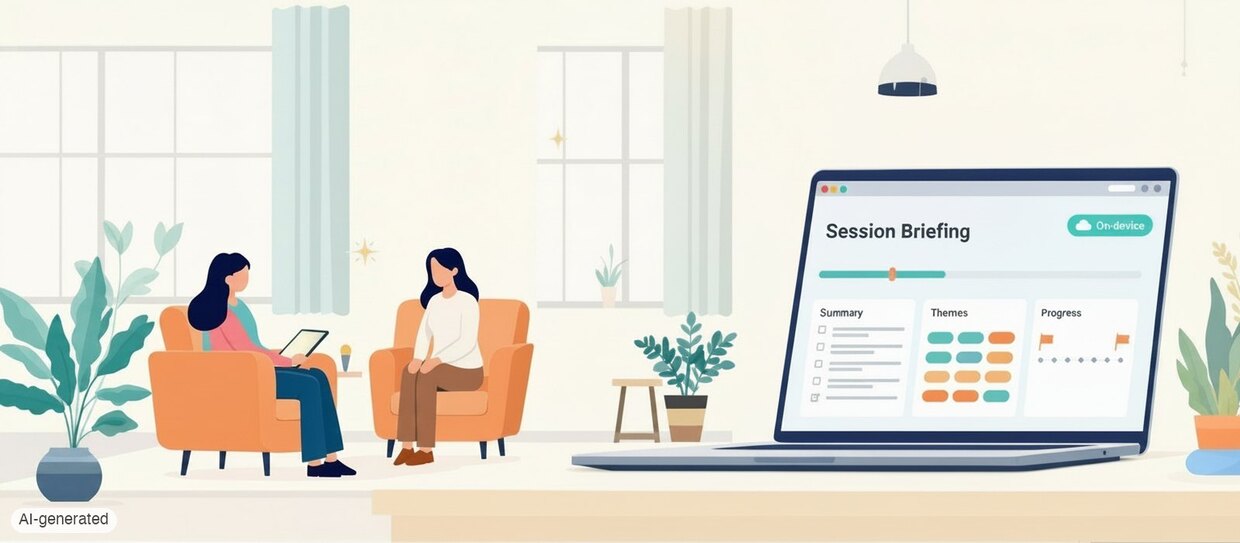
Psychotherapists routinely look back at their sessions to write notes, prepare the next session, or discuss a case in supervision. A single session, however, holds more than anyone could retain in full, and systematically revisiting recordings has long required exhaustive manual effort [5]. At the same time, recent research and industry tools increasingly explore LLM based support in mental health care [2], and tools that generate session notes, code themes, and track progress are emerging. However, a key challenge remains unresolved: How can a system reliably identify what in a therapy session is relevant for the therapist's work with the case? While prior work has focused on transcription and generic summarization, there is little understanding of which annotations genuinely support therapists in their clinical work and how they should be presented [1, 3]. This thesis addresses this gap by designing and evaluating an LLM based annotation layer on top of an existing application developed at the h-lab that produces speaker separated transcripts of German therapy sessions.
Goal of Thesis
The primary goal of this thesis is to design, implement, and evaluate a system that supports psychotherapists in working with their recorded sessions through LLM generated annotations. Following a Design Science Research (DSR) approach, the thesis will:
- Review existing research on LLM based analysis of therapy sessions and on how clinicians work with AI generated outputs [1, 2].
- Derive design requirements together with clinical experts
- Implement a prototype on top of the existing local transcription pipeline that generates annotations (session notes, recurring themes, progress markers) with evidence links back to transcript and audio.
- Evaluate the prototype in realistic clinical tasks, using expert assessment by psychotherapists [4]
Requirements
- Strong programming skills (Python; FastAPI).
- Familiarity with large language models
- Understanding of the Design Science Research methodology and ability to conduct user evaluations (or the willingness to familiarize yourself with them)
- Strong time management and communication skills and proficiency in English.
References
[1] Ademaj, G., Zhang, X., Abbasi, A., Sarker, S., & Sarker, S. (2025). Designing Support for Sensemaking in Multimodal, Multi-model Mental Health Assessments. ICIS 2025 Proceedings, 15.
[2] Hua, Y., Na, H., Li, Z., Liu, F., Fang, X., Clifton, D., & Torous, J. (2025). A scoping review of large language models for generative tasks in mental health care. npj Digital Medicine, 8, 230. doi:10.1038/s41746-025-01611-4
[3] Spatscheck, N., Airich, K., & Wirsing, B. (2026). Why Clinicians Still Trust Humans Over (Gen)AI Systems: The Anatomy of Transparency and Algorithm Aversion in Healthcare. ECIS 2026 Proceedings, 11.
[4] Kuhlmeier, F. O., Hanschmann, L., Rabe, M., Luettke, S., Brakemeier, E.-L., & Maedche, A. (2025). Combining Artificial Users and Psychotherapist Assessment to Evaluate Large Language Model-based Mental Health Chatbots. arXiv. doi:10.48550/arXiv.2503.21540
[5] Sadeh-Sharvit, S., & Hollon, S. D. (2020). Leveraging the Power of Nondisruptive Technologies to Optimize Mental Health Treatment: Case Study. JMIR Mental Health, 7(11), e20646. doi:10.2196/20646