

Foundations of Interactive Systems
- Type: Lecture (V)
- Chair: Information Systems I
- Semester: SS 2026
-
Time:
Tue 2026-04-21
09:45 - 11:15, weekly
10.11 Seminarraum Hauptgebäude
10.11 Verwaltungsgebäude, Hauptbau (2. OG)
Tue 2026-04-28
09:45 - 11:15, weekly
10.11 Seminarraum Hauptgebäude
10.11 Verwaltungsgebäude, Hauptbau (2. OG)
Tue 2026-05-05
09:45 - 11:15, weekly
10.11 Seminarraum Hauptgebäude
10.11 Verwaltungsgebäude, Hauptbau (2. OG)
Tue 2026-05-12
09:45 - 11:15, weekly
10.11 Seminarraum Hauptgebäude
10.11 Verwaltungsgebäude, Hauptbau (2. OG)
Tue 2026-05-19
09:45 - 11:15, weekly
10.11 Seminarraum Hauptgebäude
10.11 Verwaltungsgebäude, Hauptbau (2. OG)
Tue 2026-06-02
09:45 - 11:15, weekly
10.11 Seminarraum Hauptgebäude
10.11 Verwaltungsgebäude, Hauptbau (2. OG)
Tue 2026-06-09
09:45 - 11:15, weekly
10.11 Seminarraum Hauptgebäude
10.11 Verwaltungsgebäude, Hauptbau (2. OG)
Tue 2026-06-16
09:45 - 11:15, weekly
10.11 Seminarraum Hauptgebäude
10.11 Verwaltungsgebäude, Hauptbau (2. OG)
Tue 2026-06-23
09:45 - 11:15, weekly
10.11 Seminarraum Hauptgebäude
10.11 Verwaltungsgebäude, Hauptbau (2. OG)
Tue 2026-06-30
09:45 - 11:15, weekly
10.11 Seminarraum Hauptgebäude
10.11 Verwaltungsgebäude, Hauptbau (2. OG)
Tue 2026-07-07
09:45 - 11:15, weekly
10.11 Seminarraum Hauptgebäude
10.11 Verwaltungsgebäude, Hauptbau (2. OG)
Tue 2026-07-14
09:45 - 11:15, weekly
10.11 Seminarraum Hauptgebäude
10.11 Verwaltungsgebäude, Hauptbau (2. OG)
Tue 2026-07-21
09:45 - 11:15, weekly
10.11 Seminarraum Hauptgebäude
10.11 Verwaltungsgebäude, Hauptbau (2. OG)
Tue 2026-07-28
09:45 - 11:15, weekly
10.11 Seminarraum Hauptgebäude
10.11 Verwaltungsgebäude, Hauptbau (2. OG)
- Lecturer:
- SWS: 3
- Lv-No.: 2540560
- Information: Blended (On-Site/Online)
Lecture Description
Computers have evolved from batch processors to highly interactive systems. This offers new possibilities besides challenges for designing a successful interaction between humans and computers. Interactive systems are socio-technical systems in which users perform tasks by interacting with technology in a specific context to achieve specified goals and outcomes. This lecture introduces key concepts and principles of interactive systems from a human and computer perspective. From a human perspective, we discuss selected individual characteristics, cognitive processes, the interplay between cognition and activity, as well as mental models. From a computer perspective, we introduce established interaction technologies as well as contemporary multimodal technologies (e.g. augmented/mixed reality, eye-based interaction, etc.). We also introduce established principles and guidelines for designing user interfaces. Furthermore, we describe the human-centered design process for interactive systems and supporting techniques & tools (e.g. personas, prototyping, user testing).
With this lecture, students acquire foundational knowledge to successfully design the interaction between humans and computers in business and private life. The course is complemented with a Capstone Project, where students in a team apply design methods & techniques to create an interactive prototype.
Capstone Partner
This years Capstone Project will be in collaboration with Dr. Ivo Benke and Dr. Lennard Schmidt, UX researcher at Google. 
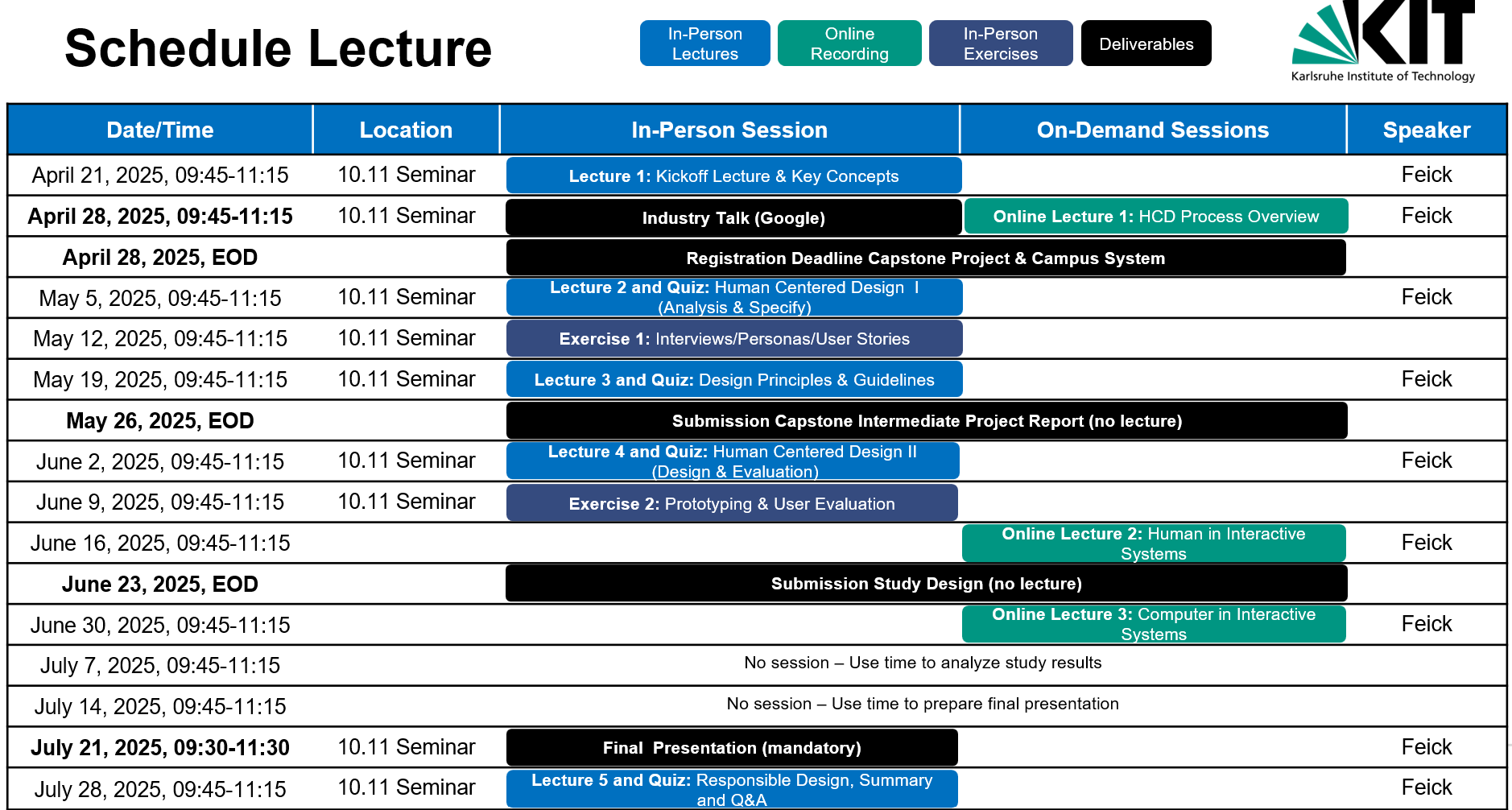
Learning Objectives
- have a basic understanding of key conceptual and theoretical foundations of interactive systems from a human and computer perspective
- are aware of important design principles for the design of important classes of interactive systems know design processes and techniques for developing interactive systems
- know how to apply the knowledge and skills gathered in the lecture for a real-world problem (as part of design capstone project)
Prerequisites: No specific prerequisites are required for the lecture
Language of instruction: English
Bibliography
Alan Dix, Janet E. Finlay, Gregory D. Abowd, and Russell Beale. 2003. Human-Computer Interaction (3rd Edition). Prentice-Hall, Inc., USA.
Hornbæk, Kasper, Per Ola Kristensson, and Antti Oulasvirta. Introduction to Human-Computer Interaction. Oxford University Press, 2025.
Further literature will be made available in the lecture.
In case of questions feel free to approach Dr. Martin Feick (martin.feick@kit.edu). Die Erfolgskontrolle erfolgt in Form einer Prüfungsleistung anderer Art (Form) nach § 4 Abs. 2 Nr. 3 SPO. Die Leistungskontrolle erfolgt in Form einer einstündigen Klausur und der Durchführung eines Capstone Projektes. Details zur Ausgestaltung der Erfolgskontrolle werden im Rahmen der Vorlesung bekannt gegeben.